Melnikov
David Diao
April 5 – June 17, 2014
David Diao, Melnikov
Since the 1980’s David Diao’s (1943) work has become emblematic of the post-modernist turn. After both a personal and a generational crisis, which distanced him from the formalist approach to painting he had practiced in the past, Diao’s canvases became the medium for a cultural critique. This critique transmitted a large dose of fascination for the modernist body of ideas and aesthetics. It is for this reason that David Diao deserves to be considered an essayist, describing this critical culture and its history throughout the twentieth century. He has revisited well-known figures like Kazimir Malevich, Barnett Newman or, more recently, Konstantin Melnikov in art series that idolized them. Surprisingly enough, David Diao uses for these series a pictorial process recalling the formal enthusiasm of that modernity he tried to distance himself from. A painting like Black and White with Chair (1984-1985) acquired the status of a manifesto, and turned David Diao into a reference for a whole generation. The composition imagined the geometrical motives of Malevich’s suprematist paintings as free-floating icons in the groundbreaking exhibition 0.10. That historical episode of the Russian avant-garde, which took place in Petrograd in 1915, suddenly revived in the New York of the 80’s with the peaking of appropriation practices. David Diao treated art history much like a musical theme, vulnerable to repetitions, rhythm accelerations and tonal variations
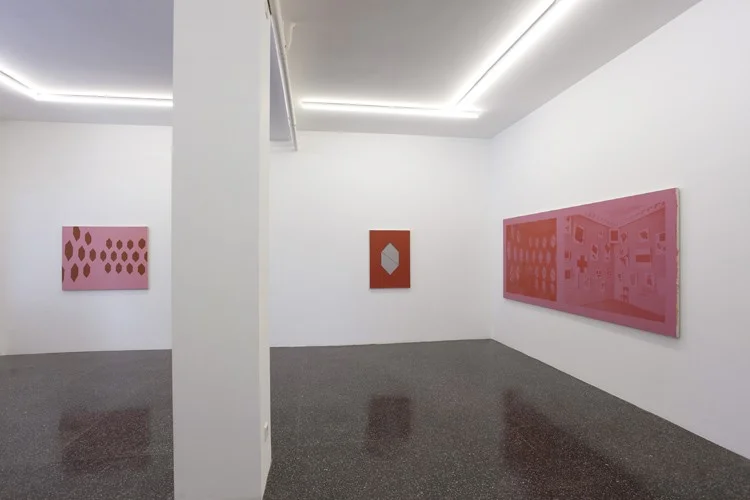
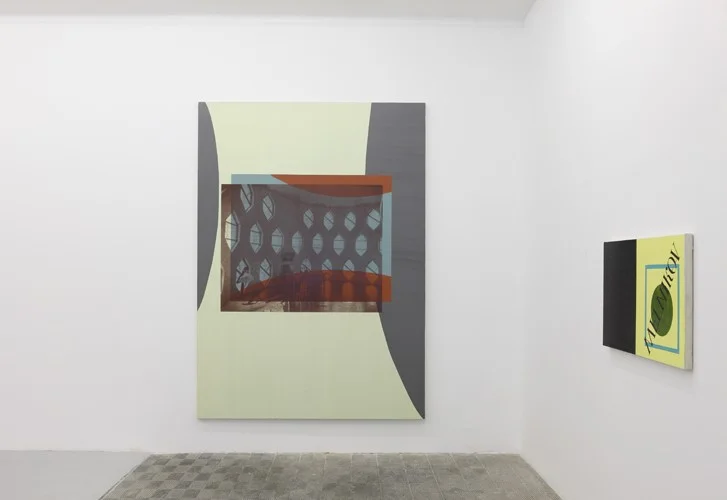
The house built by Konstantin Stepanovich Melnikov (1890-1974) in Krivoarbatsky Street, Moscow – a legendary building for modern architecture – has been the persisting leitmotiv of one of David Diao’s recent projects, completed between 2011 and 2012. The house-studio conceived by Melnikov is reminiscent of a honeycomb’s structure, which enables a very particular way of life within its walls. The different views of this space from its interior, reduced to two circular sections, generate a geometry that seems to be directly inspired by the canvases of North-American artist Elsworth Kelly. It is as if the economic difficulties of the 1920’s in the old USSR anticipated the formal repertory of post-pictorial abstraction, the precariousness of a time transformed into a depurated synthesis championing a triumphant liberalism and its artistic expression. A looped reference, which David Diao’s canvases elaborate chromatically and through iconic reiterations, similar to those that evocate the mechanical methods of pop art.
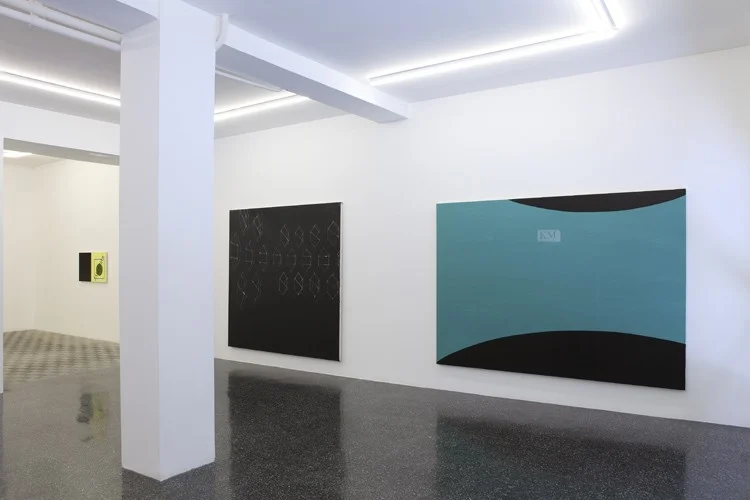
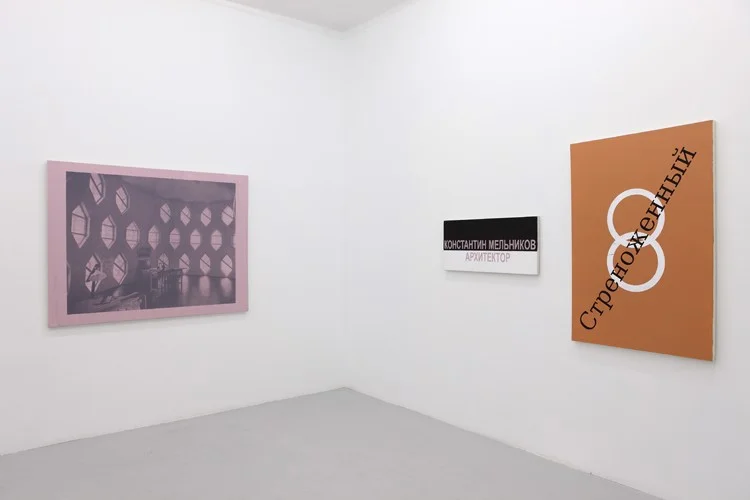
This group of works displays nominal references to Melnikov’s name, written with Cyrillic characters. The references are overlapped by the famous photograph of that corner full of suprematist works in the last futurist exhibition in 1915, recurrently quoted in Diao’s trajectory. In another work, the initials of the architect Konstantin Melnikov and those of the artist Kasimir Malevic allow us to merge both figures into one monogram. KM blurs the differences between two key figures in one the most embattled periods of Russian art. The loss of singularity expands, reflecting the homogenization that last century’s cultural and critical heritage is undergoing. Nothing is immune to myth.
In this sense, David Diao’s canvases are invaded by a discursive practice some times fanatic, others simply devote. In his work the history of modern art and its formal epic are reduced to a play of signs. The distance between the sublime and the ornamental shortens, and in this threshold a new painting blooms, rehabilitating the oldest artistic genre. His painting is born out of discredit, and rises as a new cultural form keen to review its own cultural history. In this case, Melnikov would become a complex sign whose biography is close to becoming a fable, alluding to the cycles of enthusiasm and deceit that characterize the succession of modern styles. The architect who benefitted from the favors of the soviet administration also experienced ostracism, his advanced designs for worker’s clubs forgotten soon after the 1920’s. David Diao, who has always represented himself at the margins of the artistic system, could be referring to Melnikov as a victim of cultural dynamics that, far from evolving spontaneously, are tightly monitored and disciplined. Stalinist politics were the ones that condemned Melnikov to marginalization. The cells that characterize the structure-façade of Melnikov’s famous house created the space of reclusion where he found himself trapped for the rest of his life.
The ambiguity of the sign in David Diao’s canvases provides for formal drifts and a visual rhetoric not free of a sarcasm born of disbelief. It is the same effect produced by this famous house that has miraculously survived the 20th century. David Diao’s works transform the most crucial historical moments in two-dimensional compositions. Under the appearance of a vibrantly chromatic and tempered atmosphere, old ideological fights wither away. The tragedy David Diao’s paintings feature is the loss of a tension that had characterized progress and the developing of new aesthetics. This ideological ardor is ready to enter the domestic interiors of the 21st century as well as the galleries of new institutions. In this sense, David Diao is the artist of our time, ready to touch the sore spot that nestle the contradictions of cultural politics at the end of the 20th century.
Written by Carles Guerra
David Diao has participated in Whitney Biennial 2014. His works are in collections like Whitney Museum of American Art, NY, Brooklyn Museum, NY, Albright-Knox Art Gallery, Buffalo, NY, MOMA, San Francisco, CA, Blanton Museum, University of Texas, Austin, TX, FNAC, France, MOMA, Saint Etienne, France, FRAC, Burgundy and Brittany, France, Ontario Art Gallery and Vancouver Art Gallery, Canada.