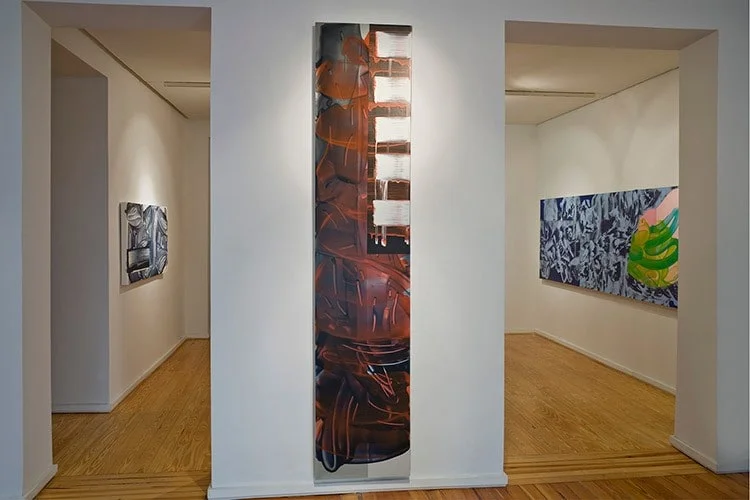
David Reed
November 19, 2011 – January 29, 2012
The abstract paintings of David Reed are influenced by various diverse artists: from the Pop art of Andy Warhol and Roy Lichtenstein to the Abstract Expressionist paintings of Newman and de Kooning. They also relate to photography and film as do other abstract painters such as Gerhard Richter.
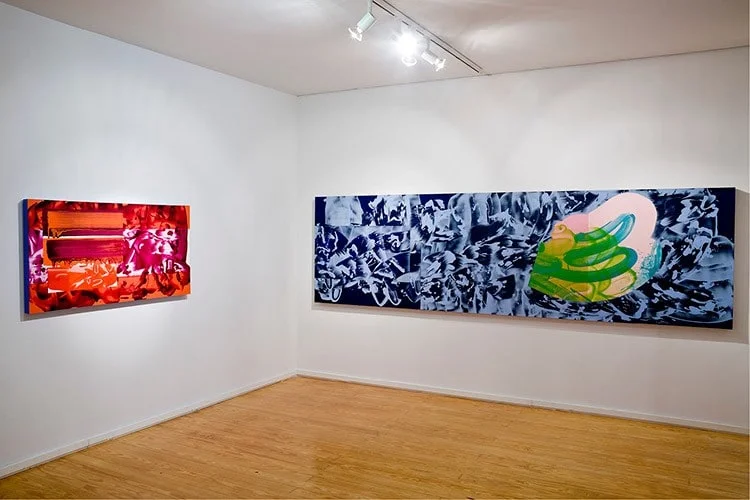
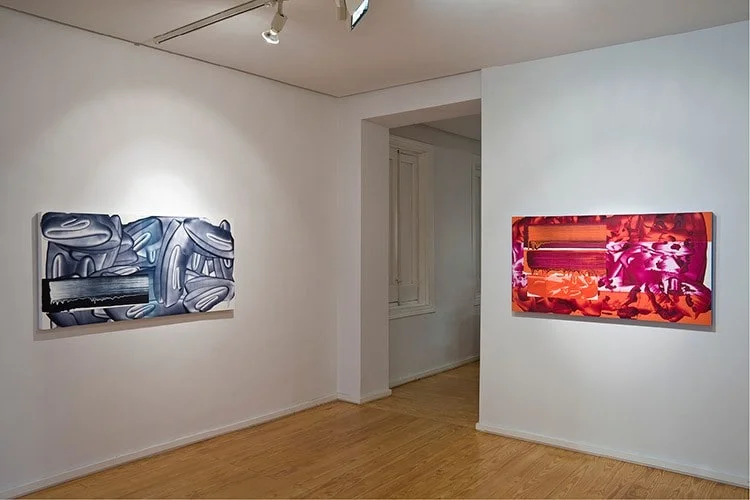
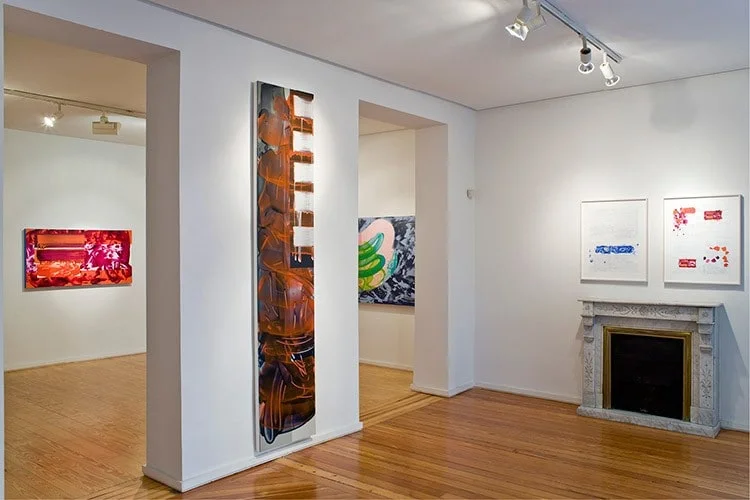
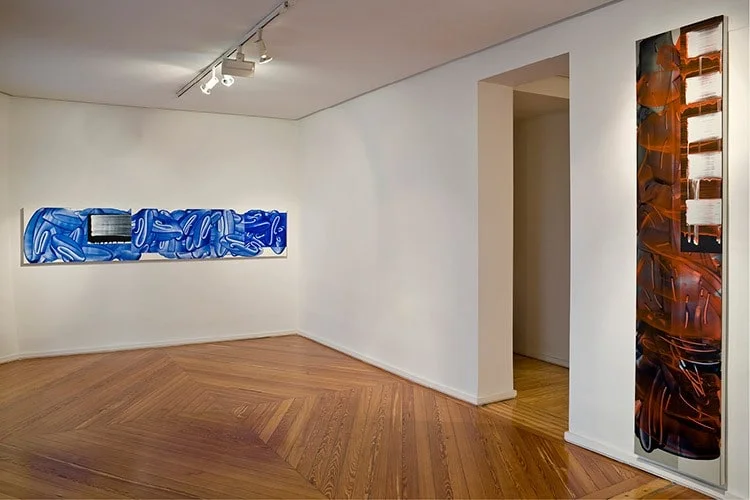
In Reed’s paintings there is no representational image. The relation to photography and film is sensed instead through movement and light and the extreme formats, horizontals related to cinemaScope for example. Nor in his paintings is there the traditional trace of the brush directed by the hand in contact with the canvas. Instead we find paint with an almost industrial, manufactured surface that brings a rational coldness with none of the melancholic pathos often associated with oil painting.
The color of the paintings is original and strong without using traditional harmonies and color combinations. The marked presence of strong post-industrial colors, almost phosphorescent, mixed with more popular colors from the industry of the fties, like green and pink of chewing gum, reinforces the industrial and impersonal nature of the color that, paradoxically, distinguishes his work and makes it unique.
Finally, the gesture. We can find an insistant spiral, like a spool of film, but it is not really a gesture, not made by the hand, but denies any impulse that was not previously calculated and precisely placed. It’s a tool that creates movement, depths of focus, and contrasts of light.
Once again, we see how David Reed deliberately and subtly avoids the emotions of abstract expressionism. To all this must be added the use of repetition, the frequent use of the same charges and structures remining of the game of variations, but not quite.
At the conceptual level, his attitude tends to be more implicit than explicit, but certainly it is as important as the formal aspect.
Undoubtedly, David Reed uses a pictorial language that it is very internalized from painting, reinterpreting it, he incorporates it, to result in a product “cold” and semi-industrial. But this is precisely what he pretends and links to his contemporaries, resulting perhaps more interesting to contextualize him not only with painting, but tridimentio- nal works and film or photography ,Jonathan Lasker, Peter Halley, Ed Rusha, Sherry Levine or Charles Ray among others, and to later artists such as Jorge Pardo or Anselm Reyle.
A few moments of a dialogue between work and viewer, brings up shadows and lights, different windows rearrange the color and space, raising connotations at once contemporary and timeless , going into new areas and concepts spaces that take us away from the traditional perception of painting. Reed’s works vibrate also in architectural tension, and incorporates technological resouces such as screenings, advertising, film or industrial design as we are constantly doing in our lives.The world reproducible force that we find and replace that often beocomes more familiar than the original.
The repetition of certain canons ends up being something so real as variations of the same concept, an image of the same work or daylight at different times projected onto an object, in this case a work that appeals our perception, movement and the pass of time, orchestrating sequencies, David Reed breaks the curse of the monotony and trans- forms it into a rich and inexhaustible source.