Cosmic Dances
Leonor Serrano Rivas
February 17 – April 30, 2022
Written in two times — — — Teresa Lanceta, Mutxamel
2019. Arabesque is in the making. Despite the tension between warp and wood, threads move as time slides towards an ever-present past and future. Thus, Leonor Serrano Rivas´ Arabesque, a palimpsest which although its origins are distant, is forged in the Alhambra when it was once staged Sergei Diaghilev's Ballets Russes. Leonor picks up that moment in time when dancers drew with movements mesmerizing figures, not dissimilar from the Islamic ornaments surrounding them, this time in terms of dancing.
Such dynamic lines, – understood and experienced as strength, knowledge and beauty – are captured in a journey for the creation of a scene via Tangier, where the artist produce along master weavers a warp in which she imprints ornamental drawings. All thanks, to a to a craft spanning centuries and different cultures. And thus, the warp somehow bodily supports the work, with longitudinal threads stretched on the loom, usually hidden by the perpendicular threads of the weft.
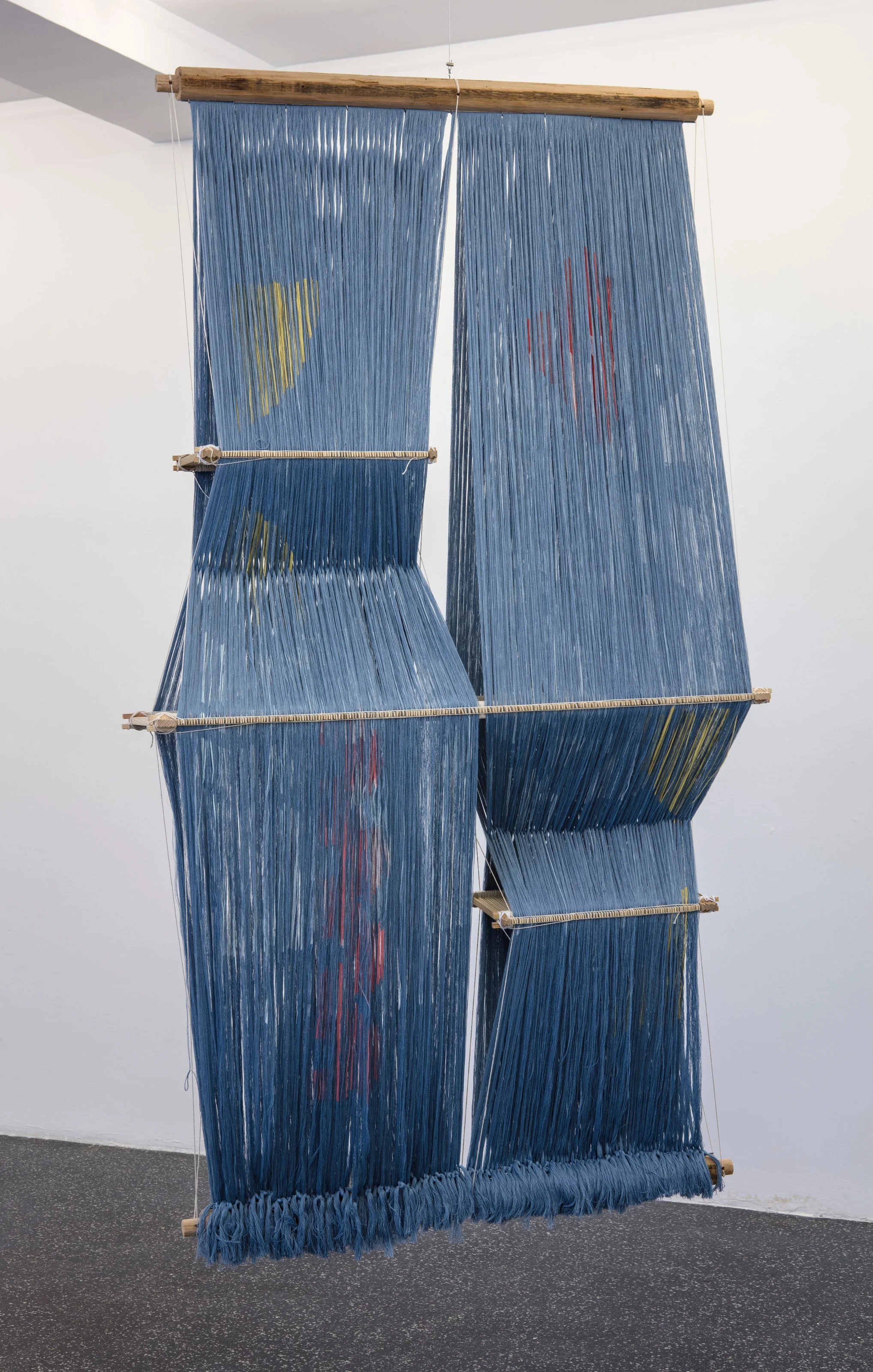
This intertwining of warp and weft forms the weave and creates patterns. However, in our case, the warp yarns assume a leading role and the weft is discarded, so it is on them that the arabesques will finally be drawn, emerging as in a new medium. Afterwards, through the consultancy with the Real Fábrica de Tapices and its expert craftsmen– in charge of weaving and producing extraordinary invaluable carpets for centuries– frames for the support of the loom models, are tailored and assembled. These frames allow the threads to intermingle at the slightest movement without losing the structure, which in Arabesque will make the drawn arabesques palpitate before our eyes.
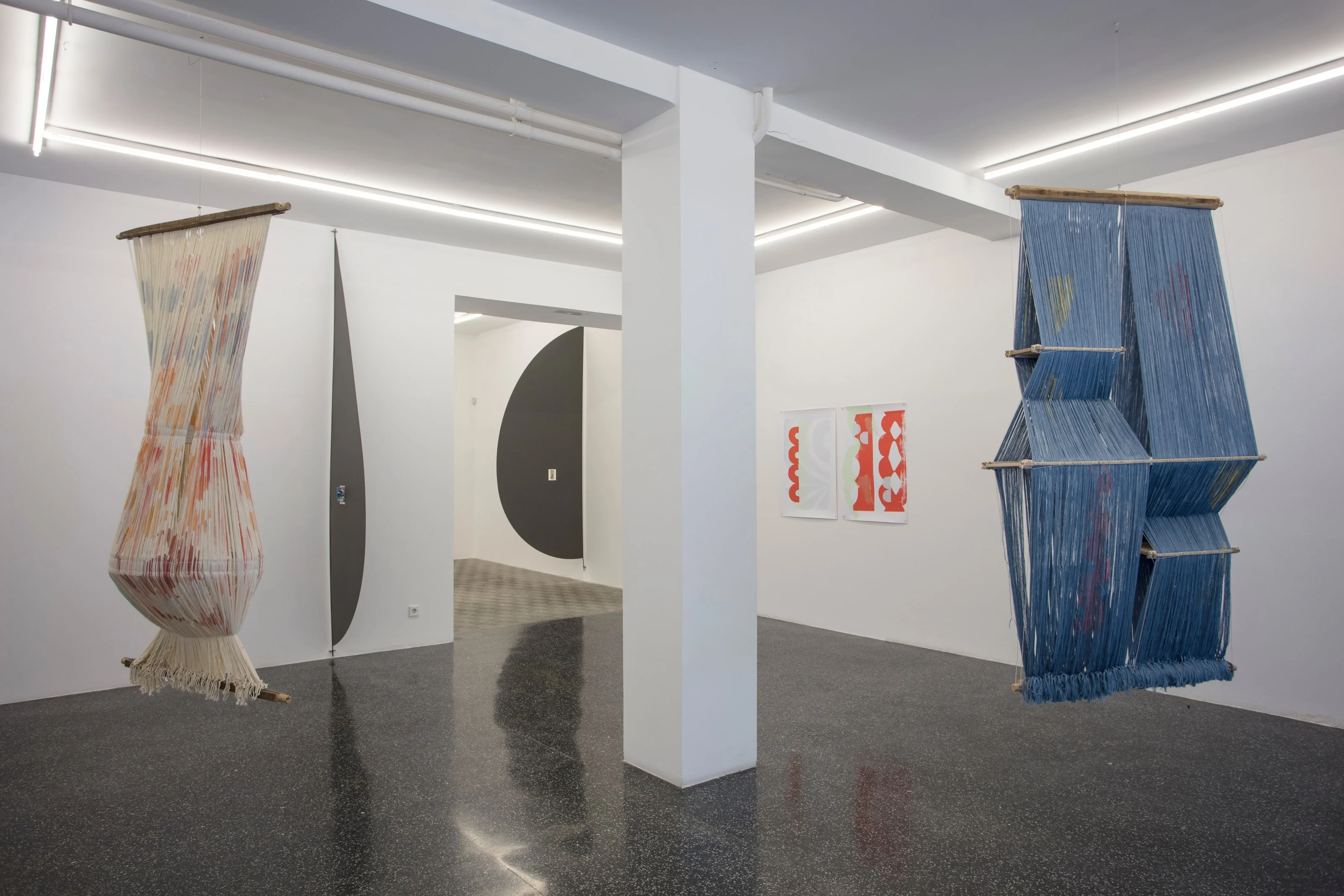
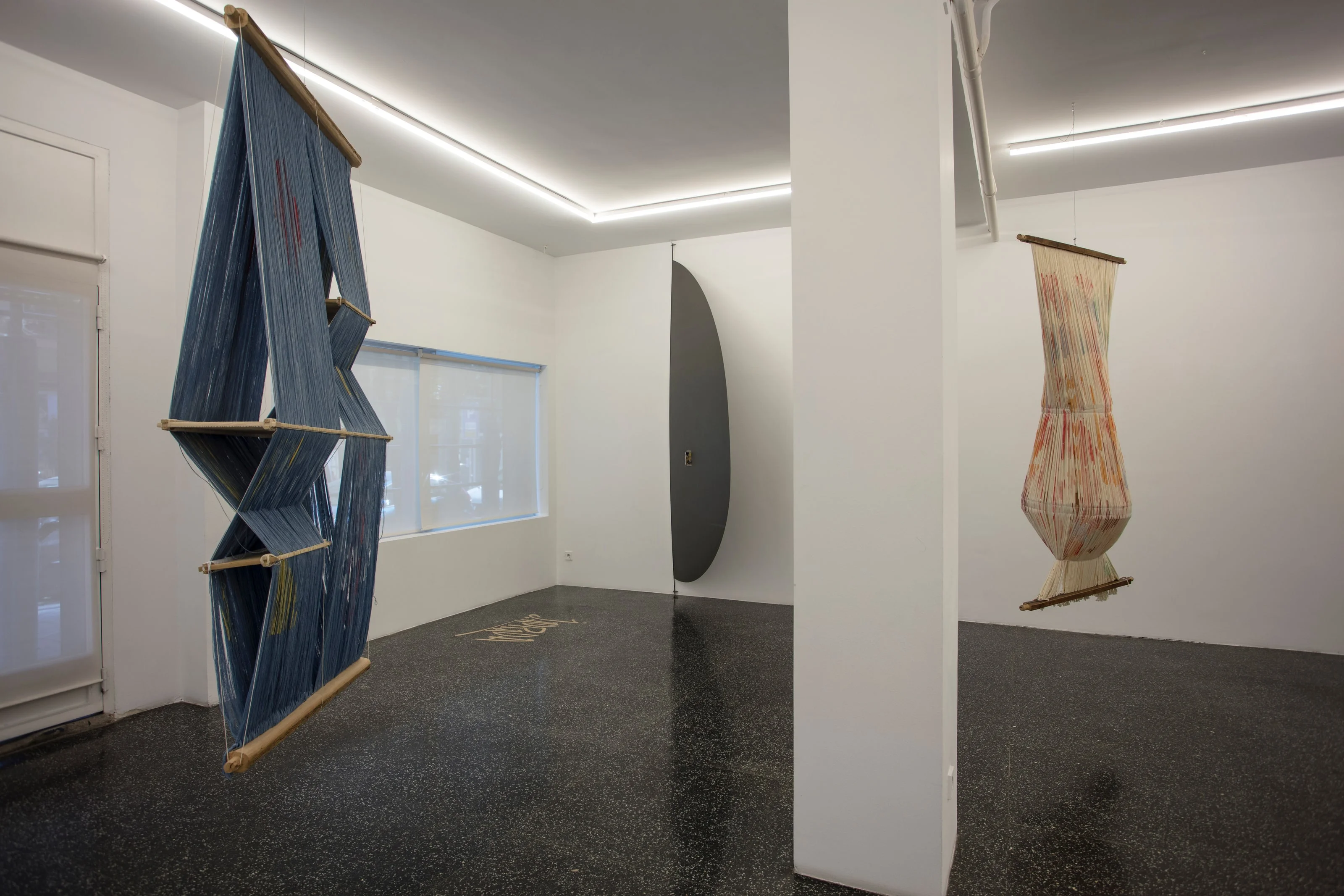
Like fabric embracing a carcass, tailored to a wooden body, Arabesque is a figure composed of lines and forms imprisoned in an endless number of screen-printed wool threads: rods, ovals and drums kept under tension by the loom´s warp. Just as the stillness of a dancer's body carry ceaseless movement, the sculptural body of Serrano Rivas's piece subtlety manifests similar promises. Hence the stillness of the loom both maintains and continually alter the now trembling ornamental hierarchy, scintillating in our relentless gaze – never truly fixed – like the slightly oscillating suspended body. The sort of light vibration, in serene equilibrium, like a well-known dance step, arabesque, which gives its title to her work and turns the dancer into a bird.
2020. Leonor has completed the project. Arabesque since its inception, has travelled a journey leading the piece closer to an inert move, to a wingless fly and quiet dance. All through process – Serrano Riva´s exhaustively researched the Alhambra and the Ballets Russes, focusing his study on the ornaments, dances and illustrations – and circumstances. Now it can be seen built, with the humble greatness that real craftsmanship brings upon: complexity and simplicity at once.
Deep inside, the collective manufacture of Arabesque lies in many hands and varied knowledge: spinners, weavers of the upmost excellence, carpenters and loom restorers along process-connoisseurs. All of them attentive to the fine effort and sustained care for detail since ancient times, and therefore essential for the project.
In Tangier, Serrano concentrates on the wool and weavers' souk, where, the warp threads take on a life of their own and resurface as a canvas for the silk-screen printing of an ornamental repertoire. That same warp-canvas became the skin and body of a sculpture, wide open and suspended in the air. Expertise translated into volume and form, through desire, revealing the architectural knowledge of Leonor, – also an architect –and bringing along architecture and art, desire and a shared effort.
In the substratum of this apparently unstable sculpture, we find an art at work imagining a new world longing for dance, as any other living being. Leonor Serrano Rivas has travelled a path that not only retakes on the Bauhaus or the Russian avant-garde´s craft dream, but even more pursues craftsmanship along excellence. As a young artist her practice is a response both to her time but also to desire, and dance here is central to that desire.
Sung by two bodies — — — — Laura Vallés Vilchez, London
2016. Undoubtedly, Teresa, the dancing body operates as a vehicle for constellations of symbols. Hence symbols articulate a fragmented imaginary sustained by a body, as a memory archive, as much as an oblivion. Aby Warburg knew this well: images survive and pierce time like ghosts of history. His Atlas Memosyne, made in his last years, posed a strategy for knowledge, but also for survival. His mental health, his schizophrenia, stimulated a work that highlights the blurred boundaries encircling reason. However, it also funnelled the birth of a constellation of images whose meaning is acquired according through interrelationship. In 2016 his 150th birthday was commemorated and, here where I live, a great meeting took place that made us vibrate with Gizburg, Mitchell or Didi-Huberman, among other figures that reminded us of the need to widen the limits of aesthetics.
But we know of the need of beauty despite its relationship with anthropology, astrology or psychiatry, and so we find in the second panel of the Warburian Atlas, to which Leonor perhaps returns on this occasion as inspiration. Six humanoid figures and mythological animal creatures, which seem to dance in unison, moved by a mysterious wind. The curvatures of their modulated bodies, however, contrast with the rectangle of the sheet, of the panel, of the exhibition room in which we try to discern the rhythm to which these figures dance: What melody do they sing? And a stealthy wind generates a chorus of three voices when we write with four hands, almost as drawing on white paper, writing on invisible winds, trapping movement.
A few months ago, Teresa said: 'I long to have a voice capable of singing. Writing is the closest I can get to that frustrated desire'. But is it possible to sing with the body, Alicia Navarro also wonders. Leonor's Cosmic Dances invites us to this exercise in which languages and bodies merge to establish new meanings.
The exhibition begins with the 'lost gesture' of which Navarro writes when, in a recent essay, she relates how the esoteric movements and alternative spiritualities of the 19th century stand as scenic possibilities evoking, for the first time, what Agamben said, 'that which escaped them'. Gestures that reveal a desire to grasp what reason cannot reach, what every religion aspires to. Hidden knowledge that hides the possibility of articulating other ways of understanding the world. A 'superior' space in which men and animals coexist in harmony and in which languages -beyond words, music, dance- cannot be differentiated. What if the language of the dancer is a 'living arabesque' as Lorca said? As you explain, Teresa, Leonor's work gives an account of that which you did not expect.
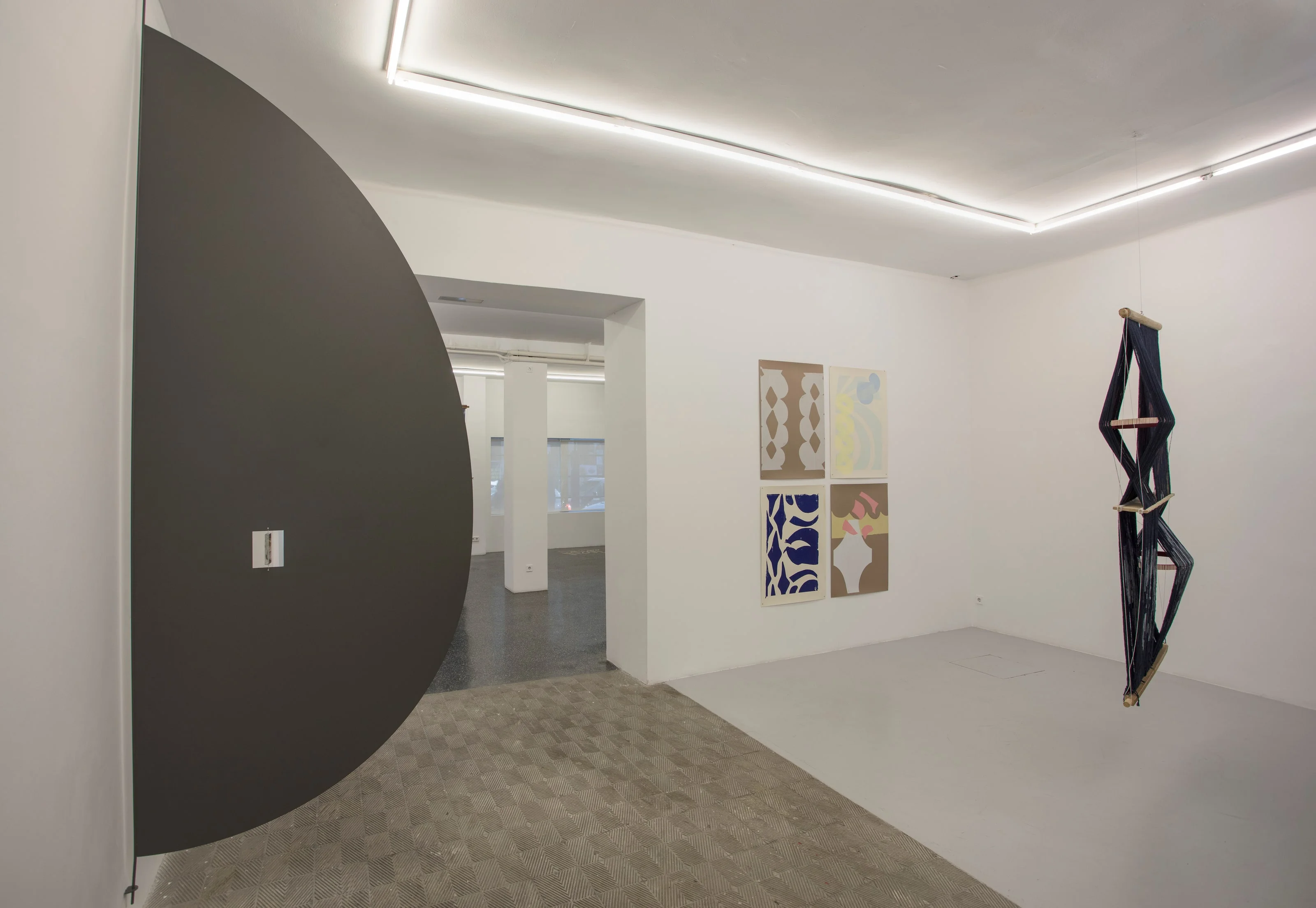
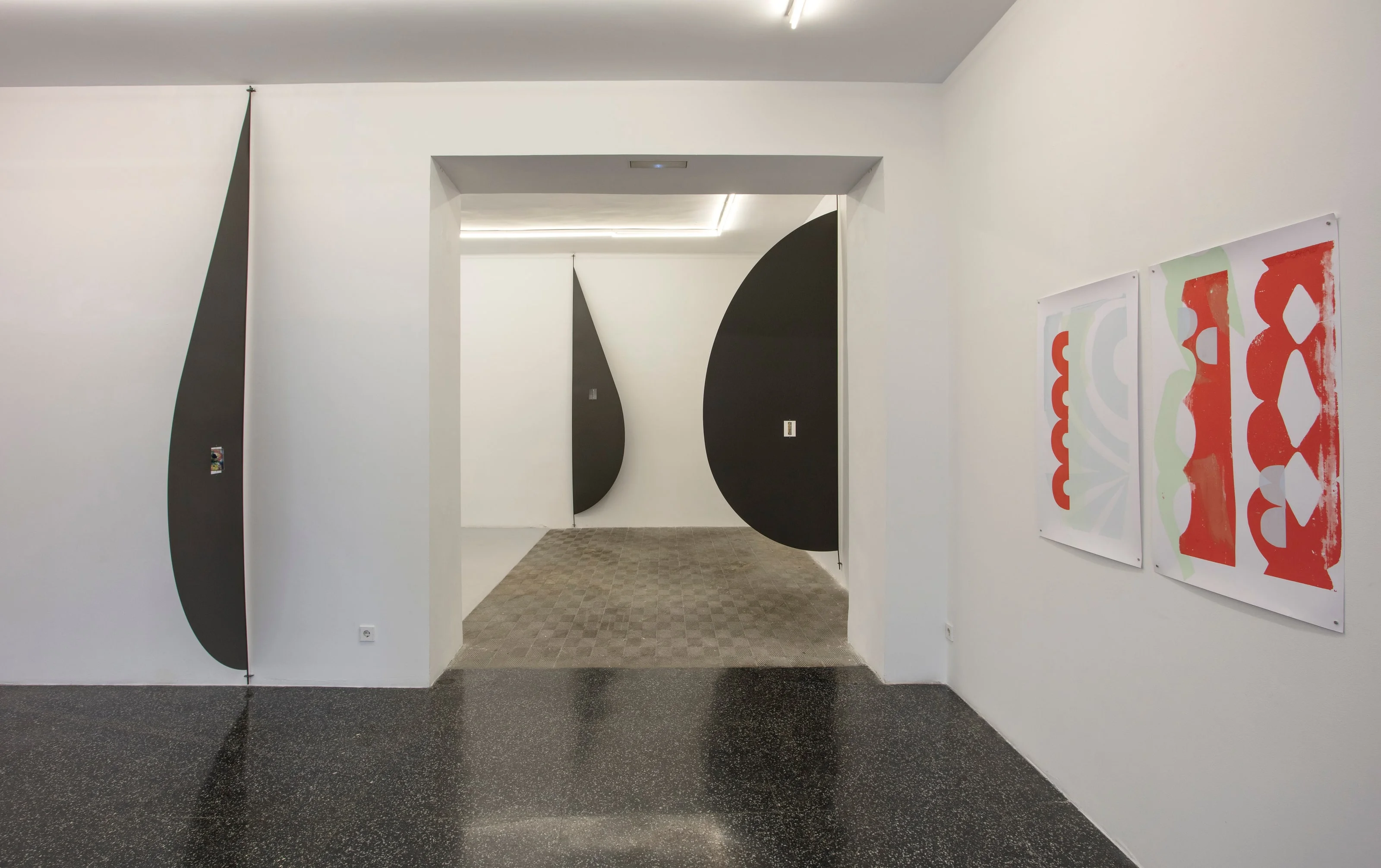
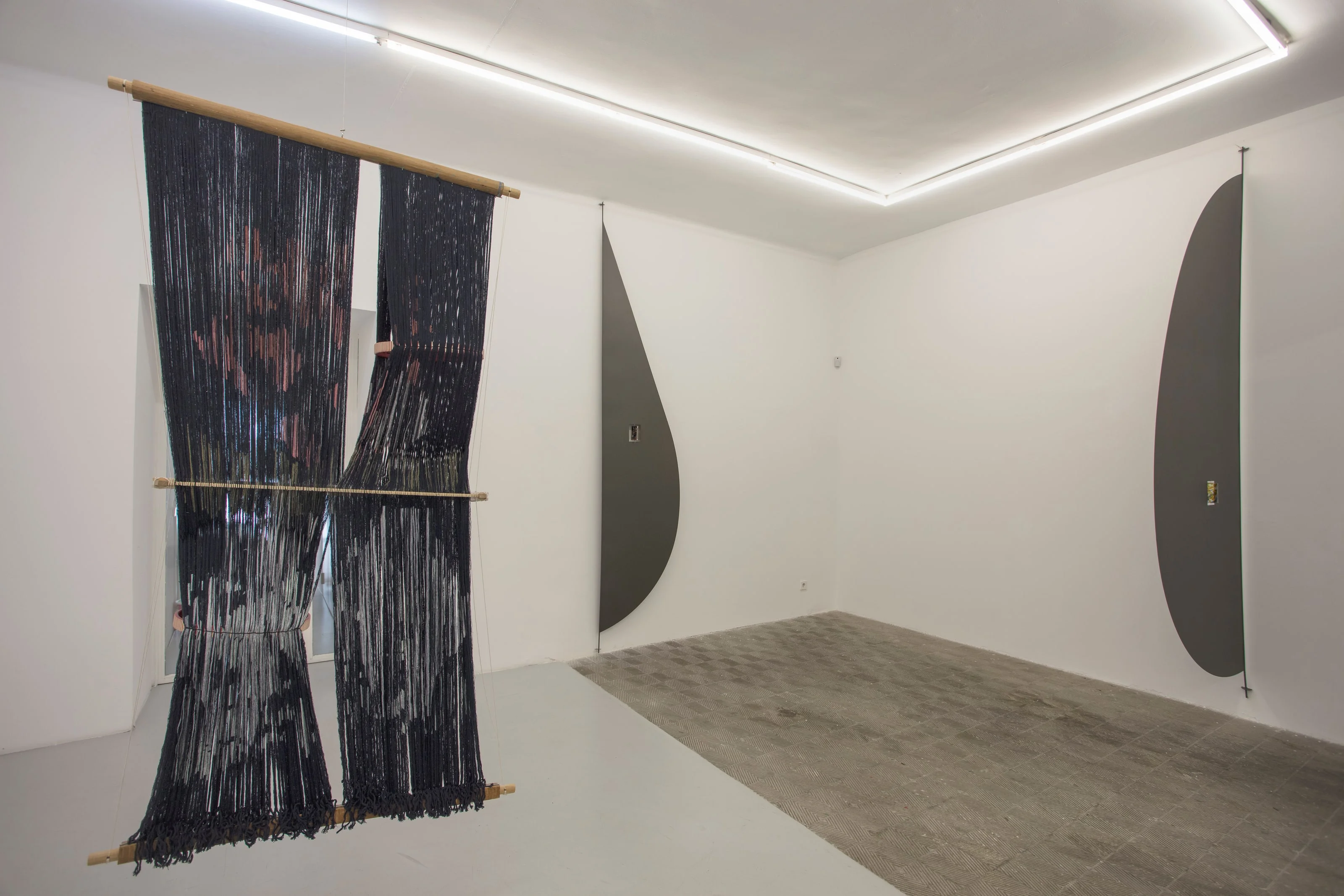
2022. Thus, this exhibition shows two great opposing presences that place us, visitors, in a triangulation with the works of art. On the one hand, we find four suspended looms of printed goat wool, among other materials, whose starting point lies in that Arabesque full of screen-printed threads tensioned by the warp of the loom. On the other hand, the exhibition presents large iron hinged plates perhaps as a fan when passing. A sort of formally semi-circular rods that, in turn, support, right in their centre, a microcosm reminiscent of a large nebula.
Like in astrophysics is often stated, we are indeed stardust and precisely here a kind of stellar wind surfaces in an odd game of scale and weights. The logic of a wind generated by an iron fan that hides a crystal painted with metals and nitrates facing each other that also form a faceted polyhedron, acting as a galaxy of possible worlds. It is a polyhedron in which blows a cosmic wind that seems to want to cross everything: land, man, animal and universe. Suspended by two fine threads, this series of world-crystals reminds us of the fragility with which a cosmos is sustained. A cosmos hanging by a thread, a world made of dust.
This mysterious dance that Leonor Serrano Rivas invites us to experience introduces different registers ranging from the handmade to the technological and implying a stealthy leap of scales from the micro to the macro. And this one, reveals what defines serendipity, and that is that in the construction of knowledge rests the accident, the chance beyond the discovery or conscious search. Like the same unforeseen fortune that has brought us to this point: to this document written in two tenses whose words are carried away, words sung by our two bodies.
Leonor Serrano Rivas (1986, ES) lives and works between Málaga (ES) and Oxford (UK). She graduated from MFA Fine Arts, Goldsmiths University of London in 2015 and is currently pursuing a PHD in Fine Arts at Slade School of Art. Recent solo exhibitions and performances include: Matadero, Madrid, ES (2019-2020); C3A, Cordova, ES (2019); The Swiss Church, London, UK (2017); Chisenhale Studios, London, UK (2016); Serpentine Galleries, London, UK (2014). Recent group exhibitions include: CAAC, Seville, ES (2021); Centro Cultural de España en México, Mexico City, MX (2020); CAAC, Seville, ES (2019); V22, London, UK (2018); Foundation Botín, Santander, ES (2018); CA2M, Madrid, ES (2018); Platform Revolver, Lisbon, PT (2017); Bluecoat Gallery, Liverpool, UK (2016). Serrano Rivas has been the recipient of a number of prizes including the Alhambra Prize 2019, ARCO Madrid Young Art award and the Caja Madrid Art Projects Prize. Leonor is currently preparing a solo show for Museo Nacional Centro de Arte Reina Sofía (MNCARS) opening in autumn 2022.